
** PRE-Order ( Ship before 14 Aug ) **
Sony FX5 Overview
Expert Take: Sony Made the Cinema Camera You Always Wanted
For years, filmmakers have found themselves choosing between the portability of the FX3 and the production-ready workflow of the FX6. The FX5 bridges that gap with surprising capability. The internal X-OCN recording, Open Gate capture, three base ISO, improved stabilization, in addition to the stacked sensor, all solve real production challenges rather than simply adding specifications to a brochure. It responds quickly, adapts quietly, and easily became an extension of the self instead of a piece of gear.What stands out the most is how balanced the camera feels, not only in terms of performance but in its physicality. Nothing appears included simply to inflate a feature list; instead, every improvement contributes to a smoother and more efficient shooting experience. Whether you’re operating solo, working on a documentary, or building a commercial production, the FX5 feels less like another camera in the Cinema Line and more like the camera many current and future filmmakers have been waiting for.
— Rosemary Ryan, B&H Camera Expert
The FX5 is a wholly new entry into Sony’s ever-expanding Cinema Line. It fits neatly in between the compact FX3-with which the FX5 shares a form factor-and the more seriously equipped FX6. Each one has its own set of features and tools that make it better suited to different types of video production. The biggest change to note is that the FX5 has moved to a next-gen sensor technology with its 16.6MP 5K fully stacked CMOS compared to the 12MP BSI CMOS of the FX3 and FX6. Here’s a closer look at how the FX3 and FX6 are positioned in relation to the FX5.
The FX3 was the ultimate handheld compact cinema camera from Sony when it first launched, and its performance remains among the best in the industry. Where the FX3 differs from the FX5 is that it borrows a lot from the Alpha series; the menu and controls are easier for users who also use mirrorless cameras like an a7R VI. Plus, the FX3 has a physical shutter and proper still image capture (including raw) for dual-purpose use.
Looking at the FX6, the FX5 is much closer in menu, features, and operation than the FX3. However, the FX6 still maintains many features expected of a traditional production cinema camera, including pro-quality connections (e.g., SDI), more physical controls, a built-in electronic ND filter (versus the stabilization of the FX5), and compatibility with Sony’s larger BP-U series battery packs.
For a more detailed comparison of Sony’s Cinema Line, please click here.
- Newly developed 16.6MP (5K) full-frame fully stacked Exmor RS CMOS sensor
- BIONZ XR2 with integrated AI processing unit for improved AI-based subject recognition autofocus and AI-based auto white balance
- Internal recording up to 5K Open Gate (3:2) at 60 fps in X-OCN (LT/C1/C2)
- Three Base ISO (800/4000/12800) and Dual Gain option for 16+ stops of dynamic range
- Revamped user interface and BIG 6 menu with optimized control scheme and multifunction dial
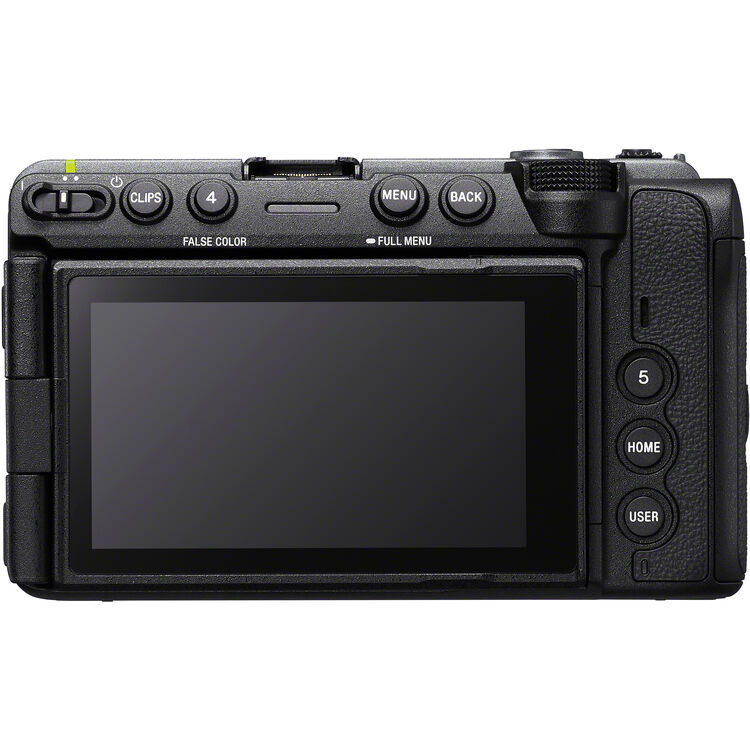
- Large 3.5″ widescreen (16:9) 4-axis multi-angle touchscreen LCD and optional dedicated electronic viewfinder
- Additional monitoring tools: false color, waveform, vectorscope, focus map, and built-in anamorphic de-squeeze options
- Enhanced connectivity with two USB-C ports, Ethernet, full-size HDMI, and headphone and mic jacks
- Dual CFexpress Type A/SD memory card slots
- High-capacity NP-SA100 battery pack with over two hours of recording time
Who is it For?
The FX5 is designed for filmmakers who need professional camera performance in a compact, highly adaptable platform. It is equally suited for experienced content creators, documentary filmmakers, commercial content creators, commercial cinematographers, freelance videographers, and production companies looking for a camera capable of moving seamlessly between handheld operations, gimbal work, studio environments, and narrative filmmaking.
At the heart of the FX5 is a newly developed 16.6MP full-frame stacked Exmor RS CMOS sensor designed to maximize readout speed, dynamic range, and low-light performance.
- The stacked architecture enables faster data processing while reducing rolling shutter artifacts, making it well suited for fast-moving subjects and handheld productions.
- Combined with Sony’s advanced color science, the sensor produces natural tonal transitions, refined highlight retention, and cinematic color reproduction suitable for both immediate delivery and extensive post-production workflows.
Expanding creative flexibility with internal Open Gate recording in a 3:2 aspect ratio, the FX5 allows creators to maximize the full sensor area while providing additional flexibility for reframing, multiple aspect ratio deliveries, and visual effects work. Internal X-OCN recording further enhances professional workflows by preserving tonal information and color precision within a raw-based format.
Together, these recording options provide the latitude required for demanding commercial, cinematic, and post-production environments.
What is X-OCN?
X-OCN (eXtended tonal range Original Camera Negative) is Sony’s compressed, and lightly processed, raw camera format. Already popular and groundbreaking on Sony’s CineAlta line of high-end professional cinema cameras (e.g., VENICE and BURANO), this powerful format has finally made its way into the FX series with the launch of the FX5. X-OCN takes all the benefits of raw but uses advanced encoding techniques to create a much smaller and more user-friendly file.
Multiple flavors of X-OCN are available across Sony’s CineAlta lineup, including the maximum quality X-OCN XT (Extreme) and balanced X-OCN ST (Standard). The FX5, owing to its more compact and more accessible design, is equipped with a handful of more compressed variants of X-OCN, including a pair of newly developed options:
- X-OCN LT (Light): Indie features, TV, commercials, documentaries, and live events-preserves editing flexibility and 16-bit linear encoding. (5K24 OG: 712 Mb/s)
- X-OCN C1: Content creation, online distribution, live events, documentaries-additional compression for longer runtimes and less discerning productions. (5K24 OG: 536 Mb/s)
- X-OCN C2: Prioritizes media storage and long runtimes. (5K24 OG: 429 Mb/s)
What it Feels Like in the Hand
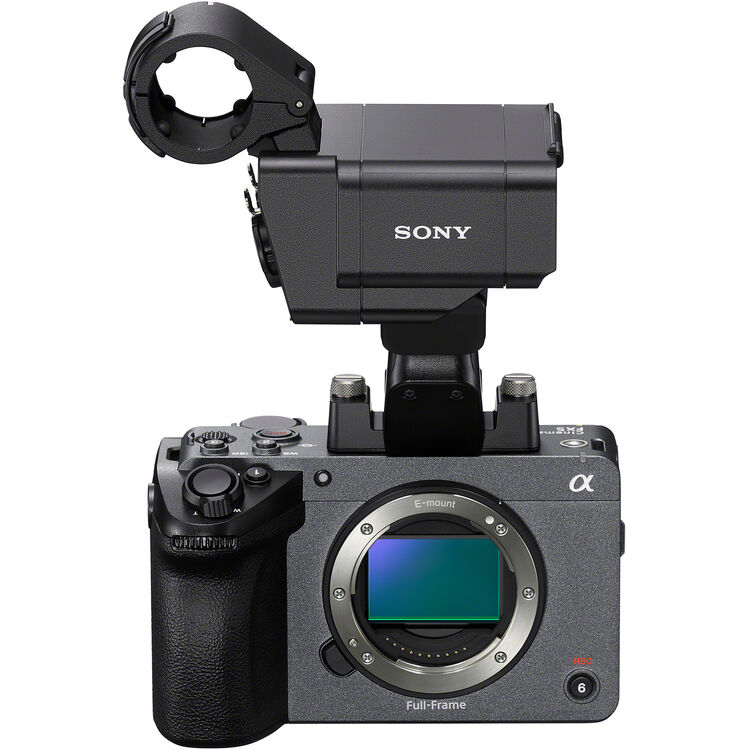
Compact enough to remain agile on a gimbal or during handheld operation, it still carries the reassuring solidity expected of a professional cinema camera. The deeper grip, refined control layout, and larger four-axis display make the camera feel purpose-built for long shooting days, while every frequently accessed control falls naturally within reach. The FX5 feels less like a compact mirrorless camera and more like a dedicated filmmaking tool designed to disappear into the creative process.
- Built-in 3.5″ widescreen (16:9) 4-axis multi-angle touchscreen—wider than the FX3
- Full-size HDMI output
- In a first for the series, there is the optional dedicated DVF-EL1 Electronic Viewfinder
Why Buy This Camera?
The FX5 is built for creators who want fewer compromises throughout the production process. Rather than prioritizing a single specification, Sony has refined nearly every aspect of the shooting experience from image capture and autofocus stabilization, monitoring, and workflow integration. Internal X-OCN recording, Open Gate acquisition, AI-assisted subject recognition, and professional monitoring tools provide greater creative flexibility while reducing the need for external accessories. The result is a cinema camera that adapts to spend more time focusing on storytelling and less time working around technical limitations.
By adding the included XLR-H2 XLR Handle Unit to the FX5, users can enjoy 32-bit float audio recording for the first time in an FX-series cinema camera.This feature takes the worry out of audio recording by eliminating clipping and offering an exceptional dynamic range. The XLR Handle Unit further improves ergonomics and connectivity with the addition of two XLR inputs, a mic mount, and a variety of physical controls to dial in audio settings.
Handheld operation and bright environments are less than ideal for any camera’s display-enter the DVF-EL1 Electronic Viewfinder. This removable electronic viewfinder, available separately, attaches directly to a proprietary connection on the top of the camera and provides a high-quality display that enhances ergonomics and works in all conditions. The display itself is an OLED with high refresh rate options, a wide color gamut, and high brightness. Plus, the ability to tilt 90° upwards makes it even more versatile.
Users should keep in mind that due to the location of the connector and its proximity to the Multi Interface Shoe that the EVF and XLR Handle Unit cannot be used at the same time.